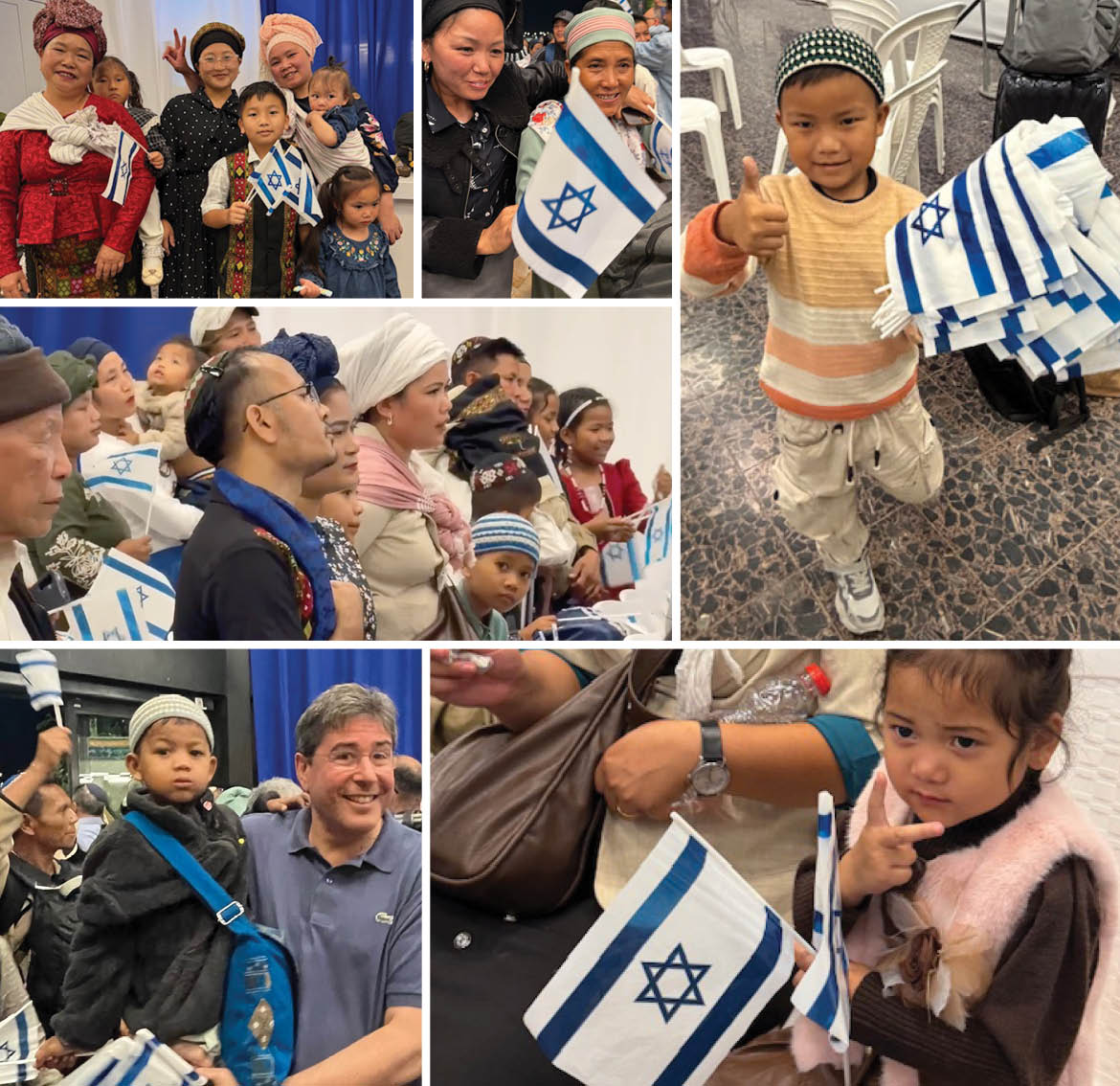
The first question for many, understandably: Who are the Bnei Menashe?
To know who they are — and why we were there — one has to brush up on the names of the 12 tribes of Israel, 10 of which were lost to history, and understand the broader story of Jewish life in India.
India is home to three better-known and long-recognized Jewish communities: the Bene Israel, the Cochin Jews, and the Baghdadi Jews.
The Bene Israel, the largest group, now mostly live in Israel. They trace their origins, over 2,000 years ago, to the persecution of Jews in Israel by King Antiochus, which led to their ancestors’ arrival on Indian soil in 175 BCE.
The Cochin Jews claim roots going back to the time of King Solomon and have clear evidence of their presence in India dating back at least 1,000 years, including copper plates granting them rights to ride elephants and collect taxes.
The Baghdadi Jews arrived more recently, as merchants in the 18th and 19th centuries, building thriving business communities in cities like Mumbai and Calcutta.
Amazingly, none of these communities experienced historical antisemitism — all were able to successfully integrate into local culture while maintaining an independent and strong Jewish identity.
In contrast to these three groups, the existence of the Bnei Menashe was mostly unknown before the late 1970s – early 1980s.
The Bnei Menashe live in the Indian states of Mizoram and Manipur, near India’s borders with Myanmar and Bangladesh, far from the country’s traditional centers of Jewish life. And unlike most of India, where roughly 80% of the population practices Hinduism, in these states, about 80% of residents are Christian, a legacy of missionary activity when British rule began in the 1800s.
But unlike their neighbors, the Bnei Menashe — who believe they are descended from the lost tribe of Menashe — did not convert to Christianity, and aspects of their religious practice have long resembled core elements of Judaism, including the belief in monotheism, observance of Shabbat, and a narrative focused on escape from Egypt.
In 2005, Israel’s Sephardic Chief Rabbi officially acknowledged the Bnei Menashe as descendants of a lost tribe. In halachic terms, they are considered Zera Israel, referring to individuals who have a historical or ancestral connection to the Jewish people. And since the 1990s, thousands of the Bnei Menashe have made aliyah, undergoing formal religious conversion upon arrival in Israel.
Today, roughly 5,000 Bnei Menashe live in Israel, while another 5,000 remain in India, eager to be reunited with their families and join the broader Jewish people in Israel.
In Mizoram, we visited the Khovevei Tzion Synagogue, which — to my surprise and delight — resembles in look and feel many of the shteibels I've spent time in on the Upper West Side of Manhattan.
There, we met Tzvi, who made aliyah 27 years ago, and now works for the Jewish Agency. All three of his children have served in the IDF, including a son who is a commander in Lebanon. As he told us, “We’re living in a very lucky generation.”
Three young women shared how excited they are to be making aliyah to Israel, to be able to experience Shabbat in Israel. To simply lead full Jewish lives in the Jewish state.
We also heard candidly about some of the challenges.
Zimra, a member of the Bnei Menashe who'd arrived in Israel with her family in 2014, described with deep emotion the difficulties they faced in absorption, without sufficient language or integration support. She is now working with the Jewish Agency to ensure that this next wave of olim from the Bnei Menashe do not share the same experience and are better equipped to fully integrate into Israeli society.