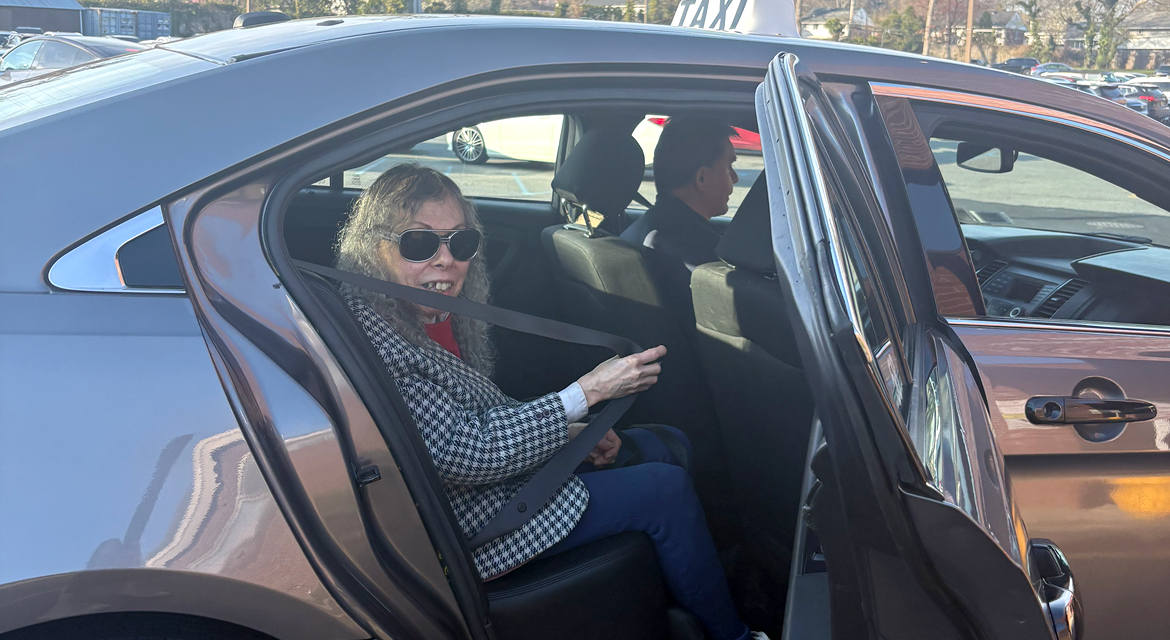
Jewish engagement has become a lot more accessible for older adults on Long Island and in Westchester.
For many suburban seniors or people with disabilities, Jewish programming at JCCs and other venues is just out of their reach. It’s not a question of what to do, but whether they can get there. And, too often, the cost of transportation means that getting there is half the battle.
A new UJA initiative, UJA on the Way, is changing that. Modeled after subsidized taxis for medical transport, the program is meant to reduce barriers during a groundswell in Jewish engagement, when a rising number of Jews are seeking connection to each other and Jewish life. But for many, including older and disabled adults, the obstacles to connecting have caused them to simply give up.
A Shrinking World
As people age and are less willing — or able — to drive, “their world really shrinks,” explains Alana Rosenstein, director of the Adult Center at the Mid-Island Y JCC in Plainview, Long Island, a UJA partner and one of five JCCs and 20 synagogues participating in the program. (The others are the Suffolk Y JCC in Commack, the Marion & Aaron Gural JCC in Oceanside, the Barry & Florence Friedberg JCC in Oceanside, all on Long Island, and the Shames JCC on the Hudson, in Tarrytown, in Westchester.) “After years of Covid-related isolation and renewed anxiety following October 7, a lot of people have been wanting to reconnect Jewishly, instead of sitting at home watching the news and traumatizing themselves. This grant has been an opportunity to address those two pieces.”
Administrators at the Shames JCC knew “travel costs were an issue, but we didn’t have a solution.” When they realized a 93-year-old member was driving herself there daily, they knew something needed to change.
“When UJA asked if we’d be interested in applying for funding for a staff person and rides, we jumped on the opportunity,” Lauren Bergida, Shames associate executive director, says.
Lowering the Feasibility Barrier
With the grant, individuals can book their own rides by calling a vetted taxi service, which bills the JCC, with a small cost-share charged to the rider. For those who may need help, a JCC staffer can make the arrangements as well. The grant also allows the JCC to rent vehicles to take members on a variety of outings, greatly reducing the cost of such trips and expanding users’ horizons and socialization opportunities. Uber, Lyft, and other commercial ride share services are not included in the program, removing any technology hurdles, as there are no apps for riders to deal with. While there are no income restrictions for participants, without the funding, says Carly Jacobs, Shames’ director of adult programs, these experiences would not be financially feasible. Since the program was implemented, Shames has seen a bump in the number of older adults attending programs regularly.
In some cases, the discounts can be used for programming at other Jewish venues, such as synagogues, as well.
Meet Some UJA On the Way Users
Ellen discovered the JCC after moving to Westchester last year and giving up her car. Thanks to UJA on the Way, she attends a range of classes; sometimes, she brings a book and hangs out in the lobby.
She’s not alone.
Jane, a widow, enjoys attending day and evening classes on Judaism and general educational topics at the Y. Without a car, she hadn’t been getting out much. “It’s felt good to be out with people,” she says. “I’d like to continue exploring the world and hope to find friendships.”
“People like knowing that on a rainy, foggy night, they have a way of getting to their sisterhood meeting,” Rosenstein adds.
“Transportation is a tremendous need, and something we’d love to be doing more with,” says Marlie Cohen, deputy CEO at the Mid-Island Y. “It’s an area where we can have real impact.”
This program is on target with our mission and values, adds UJA’s Kayleh Levy-Weller. “This work is about making sure that we don’t leave anyone behind simply because they couldn’t get to the door.”
For more information on UJA on the Way at participating JCCs, contact:
Barry & Florence Friedberg JCC: Maria Khan, 516.766.4341
Marion and Aaron Gural JCC: Julie Lauer, 516.569.6733
Mid Island Y JCC: Linda Katz, 516.822.3535, ext, 380
Shames JCC on the Hudson: Rena DeLevie, 914.918.3068, ext. 1179
Suffolk Y JCC: Jacob Zamft, 632.462.9800, ext. 151
Find more detailed information on rides to High Holiday services here >