When Michael stands, his back is straight, his frame still strong.
He was first connected to Selfhelp — a UJA partner supporting Holocaust survivors — in 2017, at the suggestion of a friend. Sitting with a social worker to review his finances, he brushed off the mention of his crushing real estate taxes. “I’m ninety-six,” he said, as if it were too late in life for such problems to matter much longer.
But with his social worker’s guidance, doors opened: home care, SNAP, government tax relief, Medicare savings. The numbers shrank — his taxes cut in half. Hearing aids came next.
Without that intervention, his savings would have vanished.
Now, he is 104.
Michael’s story stretches back to Czechoslovakia, where he was born in 1921. By 1942, he had been forced into a Hungarian hard labor brigade and later transferred to Austria. He was marked for an endless march deep into Austria that might have destroyed him, but an illness kept him back. And so he survived.
Today, thanks to our support and his unyielding spirit, Michael still stands straight and proud.
***
I’m sharing this story as we prepare to mark International Holocaust Remembrance Day, next Tuesday, January 27 — 81 years since the liberation of Auschwitz.
We are blessed that survivors still live among us today, and painfully aware of the significant continuing challenges.
In New York today, there are 13,000 survivors (just a few years before Covid, there were approximately 45,000). In Israel, there are fewer than 100,000, down from 225,000 in 2017. In five years, we expect the current numbers will dwindle by at least half.
And as survivors age, the needs dramatically intensify.
At the local level, 53% of survivors live in or near poverty — a heartbreaking and unacceptable reality. While many survivors rebuilt their lives never wanting to ask for help, more are now reaching out. Recently, when a new fund offering one-time grocery gift cards was announced, 2,100 previously unknown survivors came forward through Selfhelp to apply.
Given their history of traumatic displacement, survivors overwhelmingly prefer to receive care in their own home, which preserves independence but is far more expensive than group care.
Like all of us, they are witnessing the alarming rise in global antisemitism. For them, this isn’t the unsettling ache we all feel. This is a deeply traumatic wound torn open.
UJA created the Community Initiative for Holocaust Survivors (CIHS) in 2004, under the guidance of Ernie Michel, UJA CEO emeritus and a survivor of Auschwitz, who saw the need for additional funds to address the nuanced care that Holocaust survivors require.
Through CIHS and supplemental annual campaign funds, we provide over $7 million each year across more than 25 programs in New York and Israel to support this community.
What does this support mean for survivors?
It means social workers who care for survivors holistically, addressing everything from finances to benefits.
It means critical mental health care. It means emergency cash assistance, ensuring that a sudden home repair or medical expense does not deplete savings or push a survivor into debt.
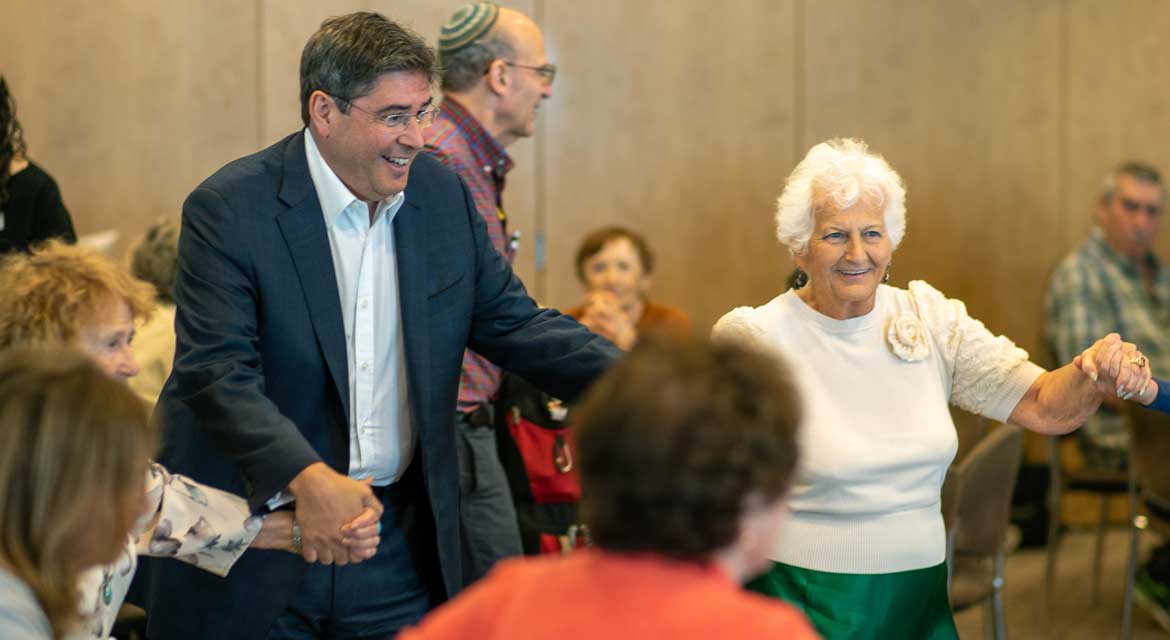
And, no less pressing, it means relief from loneliness. Programs like the joyfully rousing Coffeehouses we host every few months at UJA headquarters — filled with circle dancing, food, and friendship. Where the outside world can disappear for a few hours.